Astronaut Ethnography Project

company
MIT Space Exploration Initiative
role
Project Lead
year
2020-Present
Challenge
What might life in space be like beyond survival and productivity? For this MIT research project-turned-personal open access educational initiative, my challenge was to explore what can we learn from astronauts today to inform the future of life in space, and make that knowledge accessible to the next generation of scientists, designers, and engineers.
My Role
As research lead, I led interviews with 12+ astronauts on life in space “beyond the mission,” focused on how community and care is vital to wellbeing in extreme environments. To extend access beyond MIT, I created an open-access web archive, educational artifacts, and workshops to lower the barrier to entry to designing and building for space.
Outcomes

While providing design feedback on research prototypes at the MIT Space Exploration Initiative, I noticed a pattern in the concepts presented to our team. Each year, without fail, we’d see the same sci-fi inspired ideas — holodecks, Spider-Man gloves, and AI companions among others. While I love science fiction, I started to worry we were rehashing tropes that themselves felt narrow or outdated. Were these “cool toys that don’t address human needs,” or worse, might we be taking the wrong lessons from sci-fi?

Could we learn from today’s astronauts to inspire more novel, human-centered futures in space? This became the mission statement for the Astronaut Ethnography Project, whose aim was to catalog astronaut perspectives on life in space “beyond the mission.” Our interviews uncovered the common practices crews took to provide comfort, often improvising elements and environments to take care of themselves and each other.

Some of the challenges of microgravity, like the long acclimation periods, inability to bathe or do laundry, and orientation confusion, were expected. Other insights, such as the concepts of 'food altruism and diplomacy,' were a delightful surprise. While these data proved invaluable to in-house prototypes including my own work and led to a publication, I wanted to find a way to share what we’d learned outside MIT.
To do this, I developed an open access web archive of our research papers, design principles, and insights gathered from astronaut primary source materials, so that people beyond the academic community could review our findings and source materials. This web archive became a passion project, as I sought to find ways to lower the barrier-to-entry for engaging with space as an outsider. In addition to the web archive, I developed a deck of cards that presented our principles as interactive design challenges, alongside anecdotal astronaut evidence.
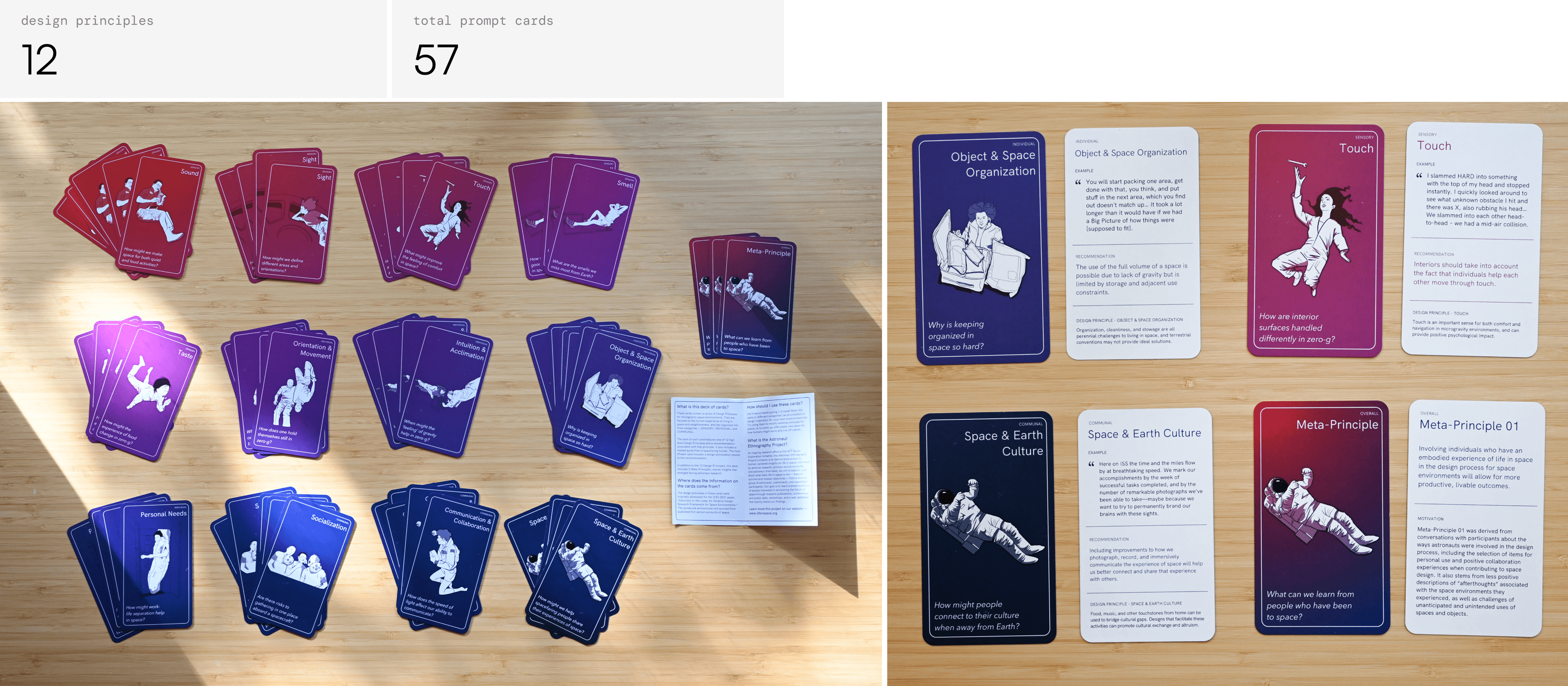
In addition to the web archive, I developed a deck of cards that presented our principles as interactive design challenges, alongside anecdotal astronaut evidence. I created a series of educational materials around the card deck, running 10 interactive design workshops with dozens of first graders, high schoolers, graduate students, and space professionals over the past two years.
Impact

To date, the Astronaut Ethnography project is live and has produced 3 conference publications, 6 spin-out projects (including Aurelia Institute's space habitat subsystems), and 10 design workshops, with participants ranging from the girl scouts to HCI graduate students and aerospace faculty at SpaceCHI. During evaluative testing, a new category of users, trainee astronauts, emerged and will be explored in future iterations of the research archive.
Until then, the Astronaut Ethnography project will continue its mission to reduce the barrier to entry for those who wish to design and build for space, while building creative confidence and a human-centered ethos to new designers and technologies working in uncharted territory.
/ case studies